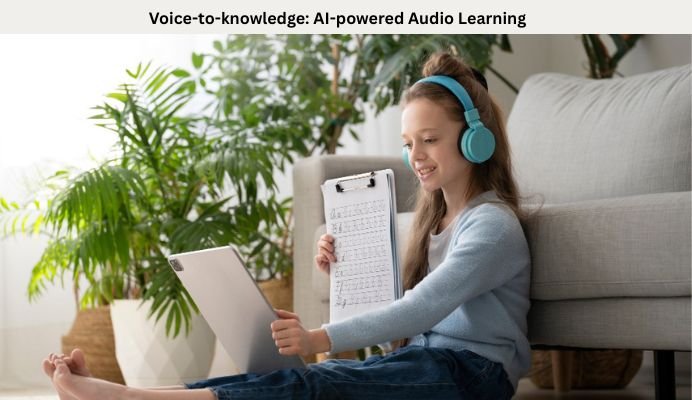
Smart speakers, podcasts, and on-demand audio have reshaped how people consume information in daily life. Education is following suit as AI-driven voice technologies shift lessons from the page to the ear, creating what experts call voice-first learning experiences.
A 2025 peer-reviewed study found that AI-assisted audio modules significantly increased student motivation and reading engagement, leading to higher academic performance. With global eLearning spend projected to surpass USD 400 billion by 2027, institutions that ignore audio risk are falling behind.
From Audio to Insight: How AI powers the pipeline
1. Speech-to-Text & Text-to-Speech Engines: Cutting-edge neural networks transcribe lectures in real time and generate natural-sounding narration in 50+ languages.
2. Semantic Indexing: AI tags key concepts, timestamps, and learner questions, turning raw audio into searchable micro-lessons.
3. Adaptive Delivery: Platforms analyze playback speed, pause frequency, and quiz scores to predict knowledge gaps and push targeted audio snippets when they’re most needed.
4. Conversational Feedback Loops: AI voice assistants answer follow-up questions on demand, reinforcing mastery without teacher intervention.
Behavioral shifts reshaping learning habits
Consumer behavior data provides compelling evidence of society’s readiness for voice-first education. Average daily podcast consumption has climbed to 54 minutes worldwide, demonstrating not just tolerance but genuine preference for extended audio content.
This represents a significant shift from the short-attention-span narrative that has dominated digital media discourse, suggesting that when audio content is well-crafted and personally relevant, learners willingly engage for substantial periods.
The educational implications become clearer when examining controlled research studies. A comprehensive 2024 analysis found that students utilizing AI-curated audio summaries completed 22% more course material compared to peers relying exclusively on traditional text-based resources.
This performance improvement stems from several factors: reduced cognitive load, improved retention through auditory processing, and the ability to consume content during otherwise unproductive time periods.
Furthermore, the multitasking advantage of audio learning proves particularly valuable for working professionals pursuing continuing education. Unlike video content that requires dedicated screen time and visual focus, audio modules can be consumed during commutes, exercise routines, household tasks, or even light work activities. This flexibility dramatically reduces the opportunity cost of learning, making education more feasible for time-constrained adults.
The spaced repetition benefits inherent in audio consumption also contribute to improved learning outcomes. Learners naturally replay audio segments they find challenging, creating organic repetition patterns that reinforce key concepts. AI systems can track these replay behaviors to identify knowledge gaps and automatically adjust content delivery for optimal comprehension.
AI-Powered Audio Learning: Overcoming Implementation Changes
1. Accessibility considerations
While voice-first learning offers significant advantages, successful implementation requires thoughtful attention to hearing-impaired learners. Best practices include providing synchronized transcripts, visual summaries, and alternative content formats.
AI-powered captioning systems can automatically generate these supporting materials, ensuring compliance with accessibility standards without additional manual effort.
2. Balancing audio with visual learning
Technical subjects often require visual demonstrations, diagrams, and hands-on practice that pure audio cannot effectively deliver. Progressive educational institutions are developing hybrid approaches that combine AI-narrated explanations with synchronized visual elements, creating multi-modal learning experiences that leverage the strengths of both audio and visual channels.
The most effective implementations use intelligent content routing, where AI systems determine optimal delivery methods based on content type, learner preferences, and contextual factors. Theoretical concepts might be delivered through immersive audio experiences, while practical demonstrations utilize interactive visual components.
3. Quality assurance and Content Curation
The democratization of AI in content creation through AI voice generation requires robust quality control mechanisms. Educational institutions must establish standards for script accuracy, consistency in pronunciation, and pedagogical effectiveness.
Fortunately, AI Automation systems can assist with quality assurance through automated fact-checking, readability analysis, and alignment verification against learning objectives.
Eight benefits of AI-powered Audio Learning
| Benefit | Proof-Point |
| Personalized pacing | Intelligent tutoring systems adjust narration speed and complexity in real time. |
| Higher motivation | Students exposed to AI audio modules show measurable boosts in engagement scores. |
| Accessibility for diverse learners | Textbook-to-audio conversion supports dyslexic and visually impaired students, expanding equitable access. |
| Multilingual reach | Instant voice translation raises comprehension among multilingual classes by over 30%. |
| Teacher time-savings | Automating instructions and recap recordings can free up to 40% of a teacher’s week. |
| Consistent quality | AI voiceovers maintain uniform tone, pitch, and pronunciation across entire courses. |
| Scalable production | Rapid generation of audio assets slashes voiceover costs and speeds course launches. |
| Proven retention gains | Gamified voice-based exercises raise skill knowledge by 14% and retention by 9%. |
Use cases across the learning lifecycle
1. Pre-Class Prep: Learners listen to 5-minute AI-generated summaries during commutes, arriving primed for discussion—an approach aligned with microlearning best practices.
2. In-Class Support: Real-time captioning and speech recognition help students with auditory processing challenges follow complex lectures.
3. Language Acquisition: AI voices model native pronunciation and provide instant corrections, accelerating speaking proficiency.
4. Certification & Compliance: Corporations convert dense policy manuals into chaptered podcasts, improving completion rates while meeting audit requirements.
5. Professional Development: Teachers consume research updates hands-free during their commute, turning downtime into upskilling time.
Future outlook: Voice as a primary interface
As natural-language AI matures, expect voice-first classrooms where lecture capture, personalized tutoring, and formative assessment converge in a single audio stream.
Edge-based speech recognition will support offline learning in low-bandwidth regions, closing global education gaps. Meanwhile, sentiment-analysis engines will detect learner frustration in vocal cues, prompting adaptive scaffolding in real time.
Conclusion
Educational leaders who integrate AI-powered audio learning today position their institutions—and their students—for success in a knowledge economy that prizes accessibility, personalization, and continuous upskilling.
The data are clear: when voice meets artificial intelligence, learning becomes not just more convenient, but measurably more effective. Those who act now will transform passive listening into active, data-driven knowledge acquisition-and gain a decisive edge in the race to educate the next generation of learners.