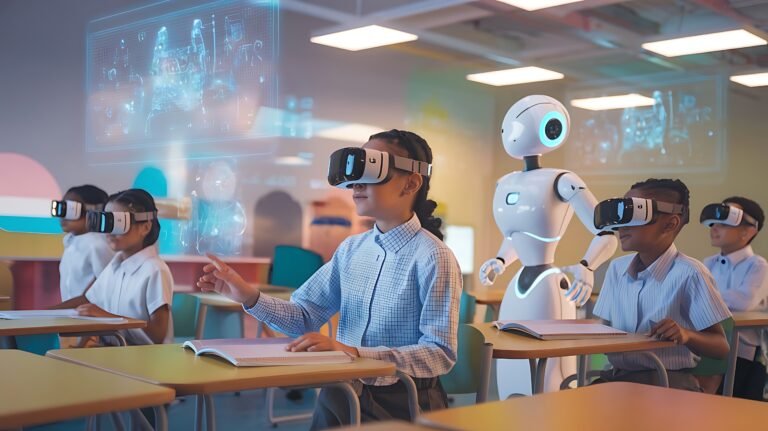

Picture this: A classroom in 2025 where 50 students sit in rigid rows, memorizing facts that will be obsolete by the time they graduate. The teacher, overwhelmed by the sheer number of learners, delivers the same lecture to everyone—regardless of whether some students grasp concepts instantly while others struggle to keep up. Sound familiar? This is the reality of traditional education, and it’s precisely why millions of students are being left behind in our rapidly evolving AI-driven world.
The statistics are sobering. According to recent data, 63% of students now choose online programs specifically for their adaptable schedules, while 70% agree that online classes better fit their lives. More importantly, the global adaptive learning market is projected to reach $5.3 billion by 2025, growing at an impressive 22.7% annually. These numbers aren’t just trends—they’re a wake-up call that traditional education is fundamentally misaligned with how people actually learn and work in 2025.
The Cracks in Traditional Education’s Foundation
The cracks in the traditional education foundation include the following
1. The One-Size-Fits-All Catastrophe
Traditional learning operates on a dangerous assumption: that all students learn at the same pace, in the same way, and require identical information delivery methods. This standardized approach, while administratively convenient, ignores the basic reality of human cognition—we’re all wired differently.
Consider the typical classroom scenario where a teacher explains a complex AI concept to 25-100 students simultaneously. While some students immediately grasp the fundamentals of machine learning algorithms, others need visual aids, hands-on experiments, or additional time to process the information. In traditional settings, the teacher moves forward based on an imaginary “average” student, leaving approximately 40% of the class either bored or confused.
This approach creates what educators call the “teaching to the middle” problem. Advanced learners become disengaged because the pace is too slow, while struggling students fall further behind because the curriculum doesn’t accommodate their learning needs. The result? A generation of students who either lose interest in learning or develop deep-seated beliefs that they’re “not good at” certain subjects.
2. The Knowledge vs. Skills Disconnect
Perhaps the most damaging aspect of traditional education is its obsession with memorization over application. Students spend years cramming facts, formulas, and theories that they’ll likely never use in their careers. Meanwhile, the AI revolution demands entirely different capabilities: critical thinking, problem-solving, adaptability, and the ability to work alongside intelligent systems.
A striking example comes from the technology sector, where companies like Google, Apple, and Microsoft have dropped college degree requirements for many positions. They’ve realized that traditional educational credentials often don’t predict real-world performance. Instead, they’re looking for candidates who can learn continuously, adapt to new tools, and solve complex problems—skills that traditional education rarely develops effectively.
The mismatch becomes even more apparent when we consider that 98% of universities now offer online classes, yet many still cling to outdated pedagogical methods. They’ve digitized the delivery but haven’t fundamentally reimagined the learning experience.
3. Teacher Burnout: The Human Cost of Broken Systems
Behind every failing educational system are overwhelmed teachers struggling with impossible demands. Large class sizes, administrative burdens, and pressure to meet standardized testing requirements have created a crisis of educator burnout that directly impacts learning quality.
When a single teacher must manage 50+ students with varying learning needs, individualized attention becomes virtually impossible. Teachers resort to crowd control rather than meaningful instruction, and students become passive recipients of information rather than active participants in their learning journey. This dynamic destroys the human connection that makes learning truly effective.
Why Traditional Education Can’t Keep Up?
The reasons why traditional education can’t keep up include the following
1. The Speed of Change Problem
Artificial Intelligence isn’t just changing individual jobs—it’s transforming entire industries at breakneck speed. The skills that were valuable five years ago may be obsolete today, and the jobs of tomorrow might not even exist yet. Traditional education, with its rigid curricula and slow adaptation cycles, simply cannot keep pace.
Consider how quickly AI tools like ChatGPT, Claude, and various automation platforms have reshaped work. Professionals across industries—from marketing to healthcare—now need to understand how to collaborate with AI systems. Yet traditional educational institutions are still teaching the same fundamental concepts they’ve been covering for decades, often without any mention of AI integration.
The half-life of learned skills has dramatically shortened. In the 1960s, skills learned in education remained relevant for about 26 years. Today, that number has dropped to just 2-5 years in many fields. Traditional education’s semester-based, linear approach cannot accommodate this reality.
2. The Personalisation Imperative
AI has raised our expectations for personalized experiences across all aspects of life. When Netflix recommends shows based on our viewing history, Spotify creates personalized playlists, and Amazon suggests products we actually want, we begin to expect similar customization from our learning experiences.
Yet traditional education delivers the exact opposite: standardized content, identical assessments, and uniform pacing. This disconnect feels increasingly jarring to students who’ve grown up in a personalized digital world. They instinctively understand that learning could be tailored to their interests, strengths, and career goals—if only the system would allow it.
3. The Global Competition and Accessibility
The AI era has also democratized access to information and opportunities. Students in remote areas can now access world-class education through digital platforms, while professionals can upskill without geographic constraints. Traditional brick-and-mortar institutions, tied to physical locations and rigid schedules, struggle to compete with this new reality.
The pandemic accelerated this shift dramatically. Organizations discovered that remote learning and work weren’t just possible—they were often more effective and efficient. This revelation has permanent implications for how we think about education and professional development.
Adaptive learning: The Path Forward
1. Real-Time Personalization at Scale
Adaptive learning systems represent a fundamental reimagining of education. Instead of forcing students to conform to a predetermined curriculum, these systems continuously adjust to each learner’s needs, preferences, and progress. It’s like having a personal tutor who never gets tired, never judges, and always knows exactly what you need to learn next.
The technology works by collecting data on how students interact with learning materials—which concepts they grasp quickly, where they struggle, what types of explanations resonate with them, and how they prefer to receive information. Machine learning algorithms then use this data to customize the learning experience in real-time.
For example, if a student learning about neural networks understands visual explanations better than text-based ones, the system will automatically present more diagrams and interactive visualizations. If another student learns better through hands-on coding exercises, the platform will provide more practical programming challenges. This level of personalization was impossible with traditional methods but is now achievable at scale through AI.
2. Immediate feedback and course correction
One of adaptive learning’s most powerful features is its ability to provide instant feedback and course correction. Traditional education often operates on delayed feedback loops—students take tests, wait days or weeks for results, and by then, they’ve moved on to new topics. This delay makes it nearly impossible to address learning gaps effectively.
Adaptive systems, by contrast, identify misunderstandings the moment they occur. If a student incorrectly answers a question about machine learning algorithms, the system doesn’t just mark it wrong—it analyzes the type of mistake, provides targeted explanations, and offers additional practice opportunities before moving forward.
This approach prevents the accumulation of knowledge gaps that plague traditional education. Instead of students building new learning on shaky foundations, adaptive systems ensure solid understanding at each step.
3. Accessibility and inclusivity
Adaptive learning also addresses accessibility challenges that traditional education has long struggled with. Students with learning disabilities, different cultural backgrounds, or varying levels of prior knowledge can all succeed in adaptive environments because the system accommodates their unique needs.
The technology can adjust reading levels, provide audio alternatives for visual content, offer translations, or modify interaction methods based on individual requirements. This inclusivity isn’t just morally important—it’s economically essential as organizations recognize the value of diverse perspectives and skills.
The Market Reality: Numbers Don’t Lie
The shift toward adaptive learning isn’t just theoretical—it’s happening rapidly across industries and educational institutions. The global adaptive learning software market is expected to grow from $2.06 billion in 2026 to $10.89 billion by 2032, representing a compound annual growth rate of 20.3%.
This growth reflects genuine demand from learners who’ve experienced the limitations of traditional methods. 60% of undergraduates now choose online education programs based on affordability, while organizations increasingly invest in adaptive platforms to train their workforce more effectively.
Corporate training, in particular, has embraced adaptive learning because businesses can measure its impact directly. Companies using adaptive training systems report faster skill development, higher completion rates, and better job performance among employees compared to traditional training methods.
AiXQP vision for adaptive learning
Platforms like AiXQP demonstrate how adaptive learning principles can be applied to address real-world educational challenges. Rather than treating all students identically, AiXQP recognizes that learners from tier-3 towns may have different needs than those from metropolitan areas, that working professionals require different pacing than full-time students, and that career goals should influence learning paths.
AiXQP’s approach addresses several critical problems simultaneously:
1. Geographic Equity: Students, regardless of location, can access world-class AI education, breaking down barriers that have historically limited opportunities based on geography.
2. Career Relevance: The platform aligns learning outcomes with actual industry needs, ensuring that students develop skills that translate into employment opportunities.
3. Flexible Pacing: Rather than forcing everyone through identical timelines, learners can progress based on their individual circumstances and learning speeds.
4. Practical Application: Instead of purely theoretical instruction, the platform emphasizes real-world problem-solving skills that prepare students for actual AI careers.
The Integration Challenge: Blending Old and New
The transition from traditional to adaptive learning doesn’t require completely abandoning existing educational infrastructure. The most successful implementations combine the social and structural benefits of traditional education with the personalization capabilities of adaptive systems.
1. Hybrid Models: Schools can maintain classroom environments for discussion, collaboration, and social learning while using adaptive platforms for individual skill development and knowledge acquisition.
2. Teacher Evolution: Instead of replacing teachers, adaptive learning can augment their capabilities. AI handles routine tasks like grading and progress tracking, freeing educators to focus on mentoring, creative instruction, and emotional support.
3. Gradual Implementation: Organizations can introduce adaptive elements systematically, starting with specific subjects or student populations and expanding based on results and feedback.
Preparing for an adaptive future
The question isn’t whether adaptive learning will replace traditional methods—it’s how quickly and effectively organizations will make the transition. Early adopters are already seeing significant advantages in student engagement, learning outcomes, and resource efficiency.
For students, this means developing comfort with self-directed learning, continuous skill development, and technology integration. The ability to learn adaptively will itself become a crucial 21st-century skill.
For educators, the shift requires embracing new roles as learning facilitators rather than information deliverers. This transition can be challenging but ultimately more rewarding as teachers see improved student outcomes and job satisfaction.
For institutions, adaptive learning represents both an opportunity and a necessity. Those that successfully integrate adaptive approaches will attract learners seeking relevant, efficient education. Those who cling to outdated methods risk obsolescence.
Conclusion
Traditional learning methods aren’t failing because they’re inherently bad—they’re failing because they were designed for a different world. In an era where change is the only constant, where AI reshapes industries overnight, and where personalized experiences are the norm, educational approaches must evolve accordingly.
Adaptive learning represents more than just technological advancement; it’s a fundamental recognition that effective education must be as unique as the individuals it serves. By embracing personalization, real-time feedback, and flexible delivery methods, we can finally fulfill education’s true promise: helping every learner reach their full potential.
The choice facing students, educators, and institutions isn’t really a choice at all. The adaptive learning revolution is already underway, driven by market demands, technological capabilities, and human needs. The question is whether we’ll lead this transformation or struggle to catch up.
For those ready to embrace the future, platforms like AiXQP offer a glimpse of what education can become: accessible, relevant, personalized, and truly effective in preparing learners for the AI-driven world ahead. The traditional classroom served us well for its time, but that time is ending. The adaptive learning era has begun.