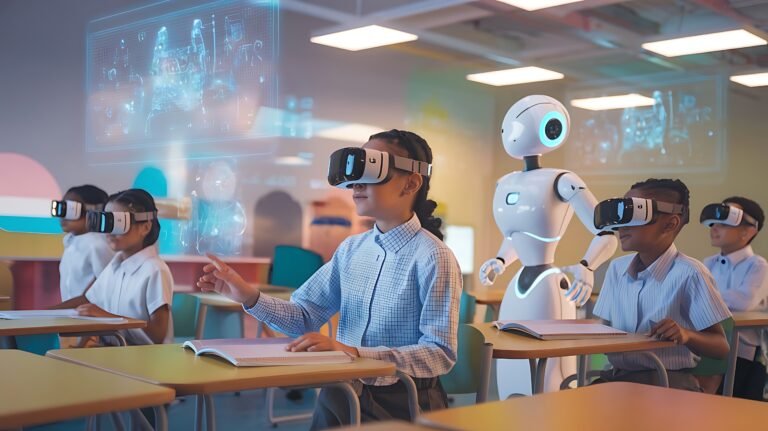

The educational landscape is witnessing a revolutionary transformation as agentic AI emerges as the driving force behind autonomous learning systems. Unlike traditional educational technologies that simply respond to user inputs, agentic AI demonstrates proactive decision-making capabilities, adapting and evolving to create truly personalized learning experiences. This technological advancement represents a fundamental shift toward intelligent educational ecosystems that operate with unprecedented autonomy and sophistication.
Understanding Agentic AI in Educational Contexts
Agentic AI represents a paradigm shift from reactive to proactive educational systems. These autonomous agents don’t just process information; they actively participate in the learning process by making independent decisions about content delivery, pacing, and assessment strategies. The primary advantage of using generative AI in content creation becomes evident when these systems generate personalized learning materials tailored to individual student needs and learning patterns.
Traditional learning management systems follow predetermined paths, but agentic AI systems continuously analyze learner behavior, performance metrics, and engagement patterns to autonomously adjust educational strategies. This represents a fundamental evolution in HR learning management systems, where AI agents take on roles traditionally performed by human instructors and administrators, creating self-sustaining educational environments.
The Architecture of Autonomous Educational Systems
Modern agentic AI systems in education operate through sophisticated neural networks that process multiple data streams simultaneously. These systems leverage AI predictive analytics to forecast learning outcomes and proactively address potential challenges before they impact student performance.
The architecture typically includes:
- Autonomous Content Curation: AI agents independently select and organize learning materials based on real-time assessment of student progress
- Adaptive Assessment Systems: Continuous evaluation mechanisms that adjust difficulty and format based on learner performance
- Proactive Intervention Protocols: Automated support systems that identify struggling learners and deploy targeted assistance strategies
- Dynamic Learning Path Optimization: Real-time curriculum adjustments based on individual learning velocity and comprehension patterns
Advanced educational platforms now exemplify this architecture through comprehensive AI solutions that adapt continuously to each learner’s unique profile, demonstrating the practical implementation of autonomous learning systems.
Revolutionizing Corporate Learning Management
The integration of agentic AI is particularly transformative in corporate learning management environments. Organizations are discovering that autonomous educational systems can address skill gaps more effectively than traditional training methods. Research indicates that companies implementing agentic AI systems report 46% faster skill acquisition rates compared to conventional learning approaches.
These systems excel in competencies based learning by automatically identifying skill deficiencies and deploying targeted interventions. The AI agents continuously monitor employee performance across various tasks and proactively recommend learning modules that address specific competency gaps, creating a seamless integration between work performance and skill development.
The Role of Predictive Analytics in Autonomous Learning
AI predictive analytics forms the backbone of effective agentic AI systems in education. By analyzing historical learning data, engagement patterns, and performance metrics, these systems can predict learning outcomes with remarkable accuracy. Studies show that predictive analytics in education can identify at-risk students with 79% accuracy, enabling proactive interventions that improve completion rates.
Modern educational technology leverages these predictive capabilities through advanced analytics solutions that provide educators and learners with actionable insights about learning progress and potential challenges, transforming reactive support into proactive guidance systems.
Personalization at Scale Through Agentic AI
One of the most significant advantages of agentic AI in education is its ability to deliver truly personalized learning experiences at scale. Traditional educational systems struggle to accommodate individual learning preferences, but agentic AI systems can simultaneously manage thousands of personalized learning paths without human intervention.
The importance of AI in education becomes particularly evident when considering the diverse learning needs of modern students. Agentic AI systems can adapt to different learning styles, cultural backgrounds, and prior knowledge levels, creating inclusive educational environments that promote equitable learning outcomes across diverse populations.
Implementation Challenges and Solutions
While agentic AI offers tremendous potential, implementation challenges exist. Educational institutions must address concerns about data privacy, algorithmic bias, and the need for human oversight. Successful implementation requires a balanced approach that leverages AI capabilities while maintaining human guidance and ethical standards.
Forward-thinking educational institutions address these challenges through comprehensive educational solutions that prepare educators to work effectively with agentic AI systems, ensuring ethical implementation and optimal educational outcomes while maintaining the human element essential to meaningful education.
Real-World Applications and Success Stories
Leading educational institutions are already experiencing the transformative impact of agentic AI. In the banking and financial services sector, organizations using AI-powered training systems report 85% improvement in employee skill development timelines compared to traditional methods.
The skill based education approach enables professionals to advance through competency-based progressions, with AI agents continuously assessing and adjusting learning paths to optimize outcomes. This approach has proven particularly effective in technical fields where rapid skill acquisition is critical for career advancement and organizational competitiveness.
Future Implications and Trends
As agentic AI technology continues to evolve, we can expect even more sophisticated autonomous educational systems. Emerging trends include multi-agent learning environments where different AI agents collaborate to provide comprehensive educational support, and the integration of quantum computing capabilities to enhance predictive accuracy and processing speed.
The global AI in education market is projected to reach $112.30 billion by 2034, with agentic AI representing a significant portion of this growth. Educational institutions that embrace these technologies early will gain substantial competitive advantages in student outcomes and operational efficiency, positioning themselves as leaders in next-generation education.
Conclusion
Agentic AI is fundamentally transforming education by creating truly autonomous learning systems that adapt, predict, and respond to learner needs in real-time. As these technologies mature, they will enable unprecedented levels of personalization and effectiveness in educational delivery.
The future of education lies in these intelligent systems that can think, adapt, and act autonomously to optimize learning outcomes for every individual learner. Educational institutions that successfully integrate agentic AI capabilities with proven pedagogical principles will lead the transformation toward more effective, equitable, and engaging learning experiences.